

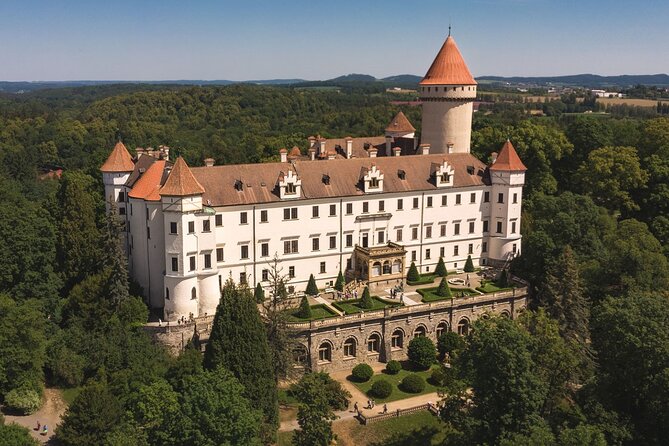
Konopiště (Czech pronunciation: [ˈkonopɪʃcɛ]; German: Konopischt) is a four-winged, three-storey château located in the Czech Republic, about 50 km (30 mi) southeast of Prague, outside the city of Benešov. It has become famous as the last residence of Archduke Franz Ferdinand of Austria, heir to the Austro-Hungarian throne, whose assassination in Sarajevo triggered World War I. The bullet that killed him, fired by Gavrilo Princip, is now an exhibit at the castle's remote museum. The castle was apparently established in the 1280s by Prague Bishop Tobiaš as a Gothic fortification in the style of a French castle with a rectangular plan and round towers protruding from the corners, making the most effective defence possible. Accounts show that the Benešévic family from nearby Benešov were the owners in 1318, and that in 1327 the castle passed into the hands of the Šternberks. In 1468, it was conquered by the troops of George of Poděbrady after a siege that lasted almost two years. In 1603, the estate was purchased by Dorota Hodějovská of Hodějov, who made Renaissance alterations to the old gothic fortification. The Hodějovský family fortified their property because of their active participation in the anti-Habsburg rebellion in 1620. Albrecht von Waldstein acquired the castle, and after him it was passed to Adam Michna of Vacínov. Michna gained notoriety through his repression of the serfs, who revolted against him and conquered Konopiště in 1657. The Swedes occupied and plundered Konopiště in 1648, and the Vrtba family then purchased the dilapidated structure. After 1725, they had it transformed into a Baroque style château. The drawbridge was replaced by a stone bridge, and near the east tower a new entrance was inserted in the wall. The gate which embellished it was designed by František Maxmilián Kaňka and featured statues from the workshop of Matthias Bernard Braun. In 1746, the upper levels of four of the towers were destroyed and one tower was completely demolished. During repair of the interiors, mythological and allegorical frescoes were painted on the ceilings of the great hall, and marble fireplaces with carved decorations by Lazar Wildmann were created. Archduke Franz Ferdinand of Austria bought Konopiště in 1887 with his inheritance from the last reigning Duke of Modena. He had it repaired between 1889 and 1894 by the architect Josef Mocker into a luxurious residence, suitable for a future Emperor, which he preferred to his official residence in Vienna. The extensive 225 ha (550-acre) English-style park, with terraces, a rose garden and statues, was established at the same time. He invited Wilhelm II, German Kaiser to see his roses early in June 1914. Insofar as they discussed politics, they discussed Romania, but undocumented conspiracy theories about their planning an attack on Serbia or a division of the Austro-Hungarian Empire arose at the time. Since 1921, the castle has been the property of the Czechoslovak and later Czech state, one of 90 such properties in state ownership. The Ministry of Culture was said to spend more than US$800,000 per year to maintain the castle, and it recovers about as much from entrance ticket sales and rental fees for occasional functions. In 2000, 'Princess' Sophie von Hohenberg, great-granddaughter of Franz Ferdinand and his morganatic wife Sophie von Hohenberg, filed a lawsuit seeking restitution of the castle to the Hohenberg family, which however was never recognized as part of the House of Habsburg. The lawsuit, filed in Benešov (former German name: Beneschau), sought restitution of the castle, 6,070 hectares (15,000 acres) of woodland and a brewery.

Konopiste Castle (Konopiste Chateau) Tours and Tickets
🎧 Available audio guides (5)
Konopiště (Czech pronunciation: [ˈkonopɪʃcɛ]; German: Konopischt) is a four-winged, three-storey château located in the Czech Republic, about 50 km (30 mi) southeast of Prague, outside the city of Benešov. It has become famous as the last residence of Archduke Franz Ferdinand of Austria, heir to the Austro-Hungarian throne, whose assassination in Sarajevo triggered World War I. The bullet that killed him, fired by Gavrilo Princip, is now an exhibit at the castle's remote museum. The castle was apparently established in the 1280s by Prague Bishop Tobiaš as a Gothic fortification in the style of a French castle with a rectangular plan and round towers protruding from the corners, making the most effective defence possible. Accounts show that the Benešévic family from nearby Benešov were the owners in 1318, and that in 1327 the castle passed into the hands of the Šternberks. In 1468, it was conquered by the troops of George of Poděbrady after a siege that lasted almost two years. In 1603, the estate was purchased by Dorota Hodějovská of Hodějov, who made Renaissance alterations to the old gothic fortification. The Hodějovský family fortified their property because of their active participation in the anti-Habsburg rebellion in 1620. Albrecht von Waldstein acquired the castle, and after him it was passed to Adam Michna of Vacínov. Michna gained notoriety through his repression of the serfs, who revolted against him and conquered Konopiště in 1657. The Swedes occupied and plundered Konopiště in 1648, and the Vrtba family then purchased the dilapidated structure. After 1725, they had it transformed into a Baroque style château. The drawbridge was replaced by a stone bridge, and near the east tower a new entrance was inserted in the wall. The gate which embellished it was designed by František Maxmilián Kaňka and featured statues from the workshop of Matthias Bernard Braun. In 1746, the upper levels of four of the towers were destroyed and one tower was completely demolished. During repair of the interiors, mythological and allegorical frescoes were painted on the ceilings of the great hall, and marble fireplaces with carved decorations by Lazar Wildmann were created. Archduke Franz Ferdinand of Austria bought Konopiště in 1887 with his inheritance from the last reigning Duke of Modena. He had it repaired between 1889 and 1894 by the architect Josef Mocker into a luxurious residence, suitable for a future Emperor, which he preferred to his official residence in Vienna. The extensive 225 ha (550-acre) English-style park, with terraces, a rose garden and statues, was established at the same time. He invited Wilhelm II, German Kaiser to see his roses early in June 1914. Insofar as they discussed politics, they discussed Romania, but undocumented conspiracy theories about their planning an attack on Serbia or a division of the Austro-Hungarian Empire arose at the time. Since 1921, the castle has been the property of the Czechoslovak and later Czech state, one of 90 such properties in state ownership. The Ministry of Culture was said to spend more than US$800,000 per year to maintain the castle, and it recovers about as much from entrance ticket sales and rental fees for occasional functions. In 2000, 'Princess' Sophie von Hohenberg, great-granddaughter of Franz Ferdinand and his morganatic wife Sophie von Hohenberg, filed a lawsuit seeking restitution of the castle to the Hohenberg family, which however was never recognized as part of the House of Habsburg. The lawsuit, filed in Benešov (former German name: Beneschau), sought restitution of the castle, 6,070 hectares (15,000 acres) of woodland and a brewery.
Overview
More Info
- There’s a fee to visit the castle, but the grounds can be explored free of charge.
- Some parts of the chateau may be a challenge for wheelchair-users to navigate.
- The park grounds offer great walking opportunities, so wear comfortable shoes.
More Adventures for You


0$
0$
3000$
Price From
18.00 USD
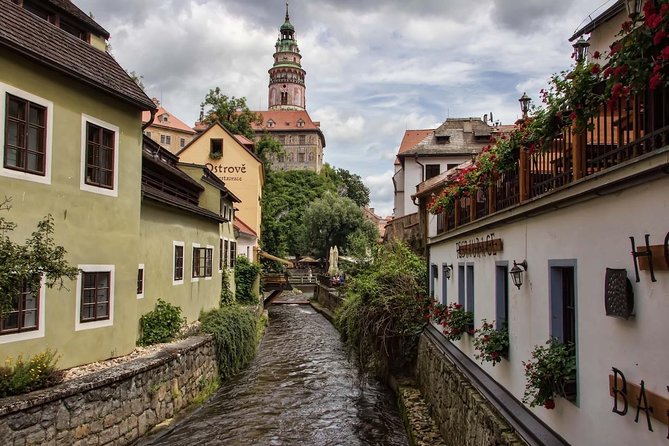
Private day trip to medieval gem - Cesky Krumlov (UNESCO) with 700 years old chateau, picturesque houses, taverns and unique atmosphere. Enjoy this amazingly well preserved place on a comfortable private day trip with lunch and castle tour admission included. On the way you can visit famous original Budweiser Budvar brewery or charming Hluboka chateau in neo-ghotic (Tudor's ghotic) style (optional stops). For games lovers tour can be extended through visiting real places from globally famous Czech game Kingdom Come: Deliverance I & II (Warhorse, 2018 & 2025). You visit Sazava monastery, castle Pirkstejn, village Rataj and more._en-US
Learn More
Price From
6.00 USD
Thirty years before his assassination in Sarajevo, Crown Prince Franz Ferdinand bought the ancient Konopiste Castle, whose roots go as far back as the 13th century, and turned it into an extravagant residence worthy of a man in his position. The interiors of the castle serve as a reminder of the fascinating life of Franz Ferdinand, one of the wealthiest men of his era and a passionate hunter, and his beautiful wife Sophia Chotek, a Czech countess who proved that love can overcome an unequal beginning. Konopiste Castle offers an insight into the lifestyle of Europe‘s nobility, as well as the opportunity to view an extraordinary collection of hunting trophies, art and weapons. The entrance fees to Konopiste castle are included. Please note that Konopiště Castle is closed on Monday! Please note that outside guides cannot guide in the interiors of state-owned castles, including Konopiste. Our guide will buy you a ticket for a group tour inside the castle. _en-US
Learn More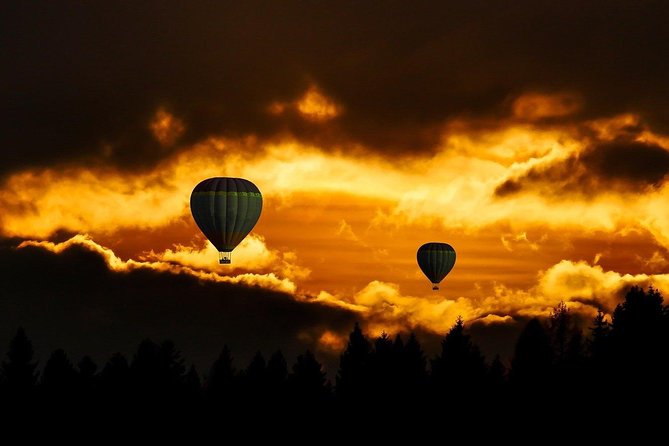
Price From
15.00 USD
Do you want a really unforgettable experience from Bohemia? Try our Spectacular Balloon Adventure. You will enjoy 1 hour-long flight with the best views in the whole Czech Republic. It is great, safe and you will have great memories. What's included Hotel Pick-up & Drop-off from your accommodation Spectacular 1 hour-long flight Pictures from your flight Tour Description The driver will pick up you in front of your accommodation and take you to the meadow outside the Prague for your ballon departure. You will have a safe instructor all the time with you and you will enjoy a spectacular 1-hour flight._en-US
Learn More
Price From
$87.70 USD
1 day scooter tour of Czech castles according to an intensive program of the eastern territory of the republic. You will see ancient monuments of Czech history of the Middle Ages and recent centuries. The unusual romantic atmosphere of these places will amaze you, and traveling on a scooter will not be boring. _en-US
Learn More
For Individuals with Hearing Loss
- Video Guide
- Hearing kits
- Speech To Text
Access for Seniors
- Distance from drop-off location to entrance: Less than 20 m
- Physical difficulty level - 3
Accessibility for wheels
- Special Parking
- Access with Portable Ramp
- Accessible elevator
- Easy without assistance
- Wide doors >= 75 cm and < 90 cm
- Accessible Toilet
Access for Visually Impaired
- Audio Guide
- Place has Special Guide Service
- Service animals permitted
As you approach the majestic Konopiste Castle, the scent of blooming flowers fills the air, adding a touch of sweetness to the atmosphere. The sound of birds chirping overhead creates a melodic symphony that welcomes you to this historic treasure.
You step inside the castle walls and are greeted by the soft, golden light streaming through the stained glass windows, casting a warm glow on the ancient stone walls. The smooth marble floors underfoot guide you through the grand halls, each step echoing softly in the spacious rooms.
In the first room, you run your fingers along the intricate tapestries that hang from the walls, feeling the raised patterns and textures that tell stories of centuries past. The colors are rich and vibrant, painting a picture of life in a bygone era.
As you move through the castle, you come across the ornate ballroom where the air is filled with the ghostly echoes of waltzing couples and the tinkling of crystal glasses. You can almost hear the music playing in the background, see the elegant dancers twirling gracefully across the floor in a whirl of silk and satin.
In the private chambers of the castle, you discover intimate moments frozen in time. The faint scent of lavender lingers in the air, hinting at the presence of the former inhabitants. You can almost see them sitting by the fireplace, lost in conversation, their laughter and whispers echoing through the centuries.
As you explore the castle grounds, you are enveloped by the peaceful serenity of the surrounding gardens. The gentle rustling of leaves in the breeze and the trickling of the nearby fountain create a soothing backdrop for contemplation. You find a quiet spot to sit and reflect, feeling a sense of connection to the past and the beauty that still lingers in this place.
Leaving the castle behind, you carry with you the echoes of history and the memories of a time long gone. The emotions stirred by your visit to Konopiste Castle linger, a mix of awe, nostalgia, and reverence for the stories etched into its walls. And as you walk away, you know that this magical place will stay with you forever, a treasured memory to cherish always.
Konopiste Castle in Prague offers audio descriptive guides for visitors who are visually impaired. They also have sensory-friendly hours available for individuals with sensory sensitivities. Visitors are encouraged to contact the castle ahead of their visit to inquire about the availability of audio descriptive guides and to confirm the sensory-friendly hours.
As a local writer in Prague, I have had the opportunity to visit Konopiste Castle multiple times, and each visit never fails to amaze me. The castle is located just a short drive from the bustling city of Prague, nestled in the picturesque Czech countryside. Stepping onto the castle grounds feels like stepping back in time, as you are surrounded by beautiful architecture and immaculately kept gardens.
One of the most striking features of Konopiste Castle is its rich history. Originally built in the 13th century, the castle has seen many owners and undergone numerous renovations over the centuries. However, it is perhaps most famously known as the former residence of Archduke Franz Ferdinand of Austria, whose assassination in 1914 sparked the events leading to World War I. Exploring the castle’s opulent interiors, filled with intricate furniture, artwork, and historical artifacts, gives you a glimpse into the lavish lifestyle of the aristocracy during that time.
As an artist based in Prague, I am always inspired by the beauty and grandeur of Konopiste Castle. The castle’s architecture, with its blend of Gothic, Renaissance, and Baroque styles, provides a stunning backdrop for creating art. The well-maintained gardens surrounding the castle are also a treasure trove of inspiration, with colorful flowers, serene ponds, and ancient trees perfect for sketching or painting en plein air.
One of my favorite experiences at Konopiste Castle is wandering through the castle’s vast collection of hunting trophies. With over 3,000 pieces on display, including mounted animal heads and weapons used for hunting, the collection is both impressive and somewhat unsettling. It offers a fascinating glimpse into the hunting culture of the time, as well as the extravagant tastes of the castle’s former owners.
Overall, Konopiste Castle is a must-visit destination for anyone traveling to Prague. Whether you are a history enthusiast, art lover, or simply looking to escape the hustle and bustle of the city, the castle offers a truly immersive experience that will leave you enchanted and inspired.
Konopiste Castle is situated approximately 44 kilometers south of Prague, making it easily accessible by both car and public transportation. Here are the various transportation options you can consider:
By Car
If you are traveling by car, you can take the D1 motorway towards Brno and then follow signs to Benesov. From there, follow signs to Konopiste. The journey by car takes approximately 40-50 minutes, depending on traffic.
By Public Transportation
If you prefer public transportation, you can take a train from Prague’s main train station, Hlavni Nadrazi, to Benesov u Prahy. From there, you can catch a bus to Konopiste. The total journey takes around 1.5-2 hours.
Accessibility
Konopiste Castle is accessible to visitors with disabilities. The castle itself is equipped with ramps and elevators to ensure accessibility for all visitors.
Ticket Booking
Tickets for Konopiste Castle can be purchased on-site at the ticket office or online through the official website. It is advisable to book your tickets in advance, especially during peak tourist seasons, to avoid long queues.
Discounts
Discounted tickets are available for children, students, seniors, and families. It is recommended to check the official website for any ongoing promotions or discounts before purchasing your tickets.
Local Amenities
- Parking: Parking is available near Konopiste Castle for a fee. There are designated parking spaces for visitors with disabilities.
- Restrooms: Restrooms are available at the castle for visitors.
- Dining Options: There is a restaurant located on the castle grounds where visitors can enjoy a meal or refreshments. Vegetarian and vegan options are also available for those with dietary restrictions. Additionally, there are cafes and snack bars nearby where you can grab a quick bite to eat.
Overall, Konopiste Castle offers a range of transportation options, accessibility features, ticket booking facilities, and local amenities to ensure a comfortable and enjoyable visit for all visitors.